
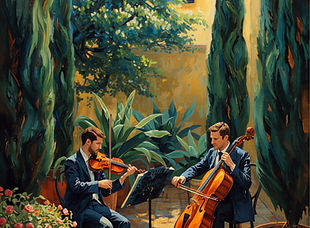
Academy Chamber Players
LUIGI BOCCHERINI
String Quintet in E major, Op. 11, No. 5
GIACOMO PUCCINI
Crisantemi
HUGO WOLF
Italian Serenade
PYOTR ILYICH TCHAIKOVSKY
Souvenir de Florence, Op. 70
Tuesday, May 25th, 2027 · 10:30 AM
Luigi Boccherini — String Quintet in E major, Op. 11, No. 5
Luigi Boccherini, an Italian cellist-composer who spent most of his career in Spain, wrote nearly a hundred string quintets and essentially invented the two-violin, viola, two-cello format. This quintet owes its fame to its third movement, the “Minuetto” — an elegant, courtly dance that has become one of the most recognizable tunes in classical music. The outer movements show off Boccherini’s lyrical ease and his idiomatic feel for the cello, the instrument he himself played with great virtuosity.
Giacomo Puccini — Crisantemi
Puccini wrote Crisantemi (“Chrysanthemums”) for string quartet in a single night in January 1890, mourning the sudden death of Amedeo, Duke of Aosta. Brief but heartfelt, the piece unfolds a single mournful theme with the same melodic instinct that would soon make Puccini opera’s reigning master of feeling. He later reused this material in the final act of Manon Lescaut, carrying the chrysanthemum’s traditional association with mourning from the concert hall onto the opera stage.
Hugo Wolf — Italian Serenade
Best known as a song composer, Hugo Wolf showed a lighter, more playful side in his Italian Serenade (1887). Inspired by Joseph von Eichendorff’s novella about a carefree, wandering hero, the single-movement work bounds along with bright tunes, abrupt mood swings, and a wink of mock drama — one of Wolf’s most charming and accessible instrumental scores.
Pyotr Ilyich Tchaikovsky — Souvenir de Florence
Composed in 1890 for string sextet, Souvenir de Florence, Op. 70, grew out of Tchaikovsky’s stay in Florence, where he also began sketching his opera The Queen of Spades. Rather than a literal travel postcard, it’s a showcase for his own melodic generosity, with Italian warmth and dance rhythms filtered through a distinctly Russian sensibility. The four movements move from songful lyricism to a dazzling, folk-flavored finale, and the work remains a cornerstone of the string sextet repertoire.