
AK Coope, clarinet
Domagoj Ivanovic, violin
Noel McRobbie, piano
CHARLES IVES
Largo for violin, clarinet, and piano
IGOR STRAVINSKY
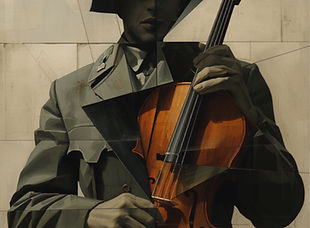
L’Histoire du soldat (The Soldier’s Tale)
PAUL SCHOENFIELD
Trio for Clarinet, Violin, and Piano
Tuesday, April 27th, 2027 · 10:30 AM
Charles Ives — Largo (for violin, clarinet, and piano)
Charles Ives wrote this brief, lyrical movement around 1901–02, reworking material from an early violin sonata he’d begun as a student. It speaks in a late-Romantic voice closer to Brahms or Dvořák than to the dissonant, tune-quoting Ives of his later fame: a single unbroken arc that opens and closes quietly, the violin spinning out a wide-ranging melody over a gentle piano ostinato before the clarinet enters and the music swells to real expressive warmth. It went unpublished until 1953, the year before the composer’s death.
Igor Stravinsky — L’Histoire du soldat (The Soldier’s Tale)
Written in Switzerland in 1918, when wartime shortages ruled out anything like a full orchestra, Stravinsky’s theater piece was scored for narrator, dancers, and just seven instruments. With writer C. F. Ramuz, he adapted a Russian folk tale about a soldier who trades his violin — and with it his soul — to the Devil for a book that predicts the future, growing rich but losing all capacity for joy. The score is a sly cabinet of borrowed popular dances — tango, waltz, ragtime, march — refracted through Stravinsky’s new, spiky neoclassical rhythm.
Paul Schoenfield — Trio for Clarinet, Violin, and Piano
Paul Schoenfield composed this high-spirited trio in 1990. Its four movements — Freylakh, March, Nigun, and Kozatske — each draw on a different Eastern European Jewish dance or song form, swinging between exuberant virtuosity and passages of plaintive, improvisatory lyricism.